User:Pixelpoepleman/SMdraft
The Supermatter Crystal is the primary power source in most stations. A Supermatter Shard can be ordered from Cargo, which works the same way, but can be moved around. Its primary features are emitting tons of radiation, making everyone who could theoretically see it hallucinate, releasing hot oxygen and plasma, heating the air around, and exploding or creating singularity/tesla if you screw up. It begins inert but being hit by an object, projectile, or laser will stimulate and activate it. It will then start producing huge amounts of radiation, which can be converted to power with the radiation collectors.
| Do NOT run into the Supermatter to commit suicide! You will be banned. |
Words of Warning
- You require safety gear. A full radiation suit and meson scanners. See (6) for more.
- Anything that bumps into the Supermatter is fundamentally annihilated. Don't touch it.
- The Supermatter is VERY DANGEROUS. Activating the Supermatter should be the last step in setting up any form of Supermatter based power! If you ordered it from cargo the crate should stay LOCKED AND SECURED until everything is ready.
- Do NOT setup the Supermatter's air alarm until you are absolutely satisfied the supermatter pipe loop. A common delamination occurs when engineers scrub the gases from the Supermatter first without replacing it with a suitable gas causing a vacuum. A vacuum will stimulate and activate the crystal quickly spawning MASSIVE amounts of plasma, oxygen, and heat resulting in an engine fire which can only be stopped by an extremely robust Atmosian.
- The Supermatter is an 'atmospheric' engine. Most of "setting up the Supermatter" involves a gas loop that is designed to cool down the Supermatter chamber. While not required, please have some knowledge of gasses or atmospheric properties.
- Hardsuits, excluding the CE's hardsuit, have limited radiation protection. The engineering hardsuit has 75% radiation protection. CE's hardsuit has 100%. Atmos hardsuit has 25%. RD's and CMO's have 60%. If working near an active Supermatter Engine, use a radiation suit or the Chief Engineer's hardsuit if permitted. Even with the 75% protection of an engineering hardsuit, you will become lethally irradiated in time.
The Safe Setup
The Supermatter engine on current (2025) rotation maps can be set up in many different ways and experienced engineers are encouraged to experiment. The less experienced engineers can refer to the safe guide below. This is a simple nitrogen setup, easy to maintain and has two methods to handle sabotage (freezer backup and N2 preset). It will almost always last the entire round, and almost always generates enough power for the entire station.
There is an old video setup guide here, but the recommended guide below has changed since that video was made.
Step One: Gear Up
- All races except IPCs, Plasmamen, and Diona will require a radiation suit

 . Look for yellow lockers marked with a black radiation symbol to get a suit and helmet.
- Why: Once the engine is started, it will generate significant amounts of radiation. Any race not immune to these effects will find themselves quickly gaining a lethal dose of radiation. While some hardsuits provide partial protection against radiation, even at 75% protection, a lethal dose will take effect eventually. Only a radiation suit and the Chief Engineer's hardsuit provide full radiation protection.
- Put on an optical meson scanner
 or engineering scanner goggles
  on meson mode.
- Why: Meson Scanners protect from hallucinations, while the suit protects from radiation. IPCs, and Plasmamen are inorganic and thus are immune to most of radiation's effects, but they CAN still suffer hallucinations. Once the engine is started, it will cause hallucinations to the unprotected eye.
- Grab both a Rapid Piping Device
 and wrench
  . You will be using these tools to edit or optimize the SM near constantly, so it's always good to keep them on your character.
- Why: The Piping Device can place or destroy pipes, as needed. While the wrench is the tool to either secure or unsecure the piping in place.
- If you are an engineer, use your PDA. Open up the Supermatter Monitor app and hit details. This will open a screen giving detailed information on the status of the crystal.
- Why: The information displayed in this app can be used to diagnose the exact state of the crystal. An experienced engineer will be able to see a delamination before it starts when familiar with the display.


Step Two: Prepare The Gas Loop
- Unwrench and remove gas pumps (green circle in picture), then replace them with straight pipes.
- Why: Whoever designed this horrible loop has no idea how gases actually operate. If you expect to be constantly pumping gases through an area as fast as possible, the pumps will actually slow them down. This is especially problematic for pumps before the space loop as the gas has yet to receive cooling.
- Toggle the gas filters (yellow square in picture) ON and set to desired gas. The first filter, the one on the green pipes, is for harvesting gases. This is often best simply replaced with a straight pipe for the same reasons as the pumps unless you need to harvest gas. For the four filters on the red pipes, these are waste filters. They separate your desired running gas from waste gas. The selected gases go on to the light blue pipes on the side, while the unselected gases go onward in the red pipes. By default the gold standard gas to choose is Nitrogen or N2.
- Why: The gas filters work by separating chosen gases from a pipe. In the safe setup, this means that N2 is removed from an array of other harmful gases that exhaust from the SM such as plasma or oxygen. The exhaust exits the red pipe and dumps into space.
- Wrench one of the red N2 canisters
 to activate the gas loop. This should be done when you have finished setting up the rest of the loop. Keep the other unconnected to save it for later. This is useful for if the engine has, for some reason, lost nitrogen or needs urgent injection of nitrogen to displace or cool the gas in the loop. Wrenching both canisters into the loop when not needed may waste the spare can.
- Why: Nitrogen (or whichever gas you end up using) must be put in the pipes in order to circulate. If you need to add other gases, you can add them in these two gas addition ports, or through the ATMOS to SUPERMATTER pump. Though the latter will require understanding some atmospherics department piping.
- Set the air alarm
 next to the core chamber. Open the air alarm menu by clicking on it. If it is locked, unlock it with a permitted ID by alt-clicking. Next click Vent Controls and turn off the external and internal regulators. Picture (click it):
- Why: Some players insist that "Internal 0" is the best setting for the vents, but it is functionally identical to simply disabling both regulators. Either way, this ensures the vents try to push all available gas into the crystal chamber. It is best to set the vents before scrubbers to prevent pulling vacuum in the chamber. If you have only added one canister of Nitrogen, this should be fine.
- Continuing to set the air alarm , back out of Vent Controls and click Scrubber Controls. Then change the scrubbers to siphon (by clicking "scrubbing") and Expanded Range. You don't need to change any of the filter settings besides the mode, since, on "siphon", all gases get sucked out. The scrubbers will show an animation if they are set up to siphon correctly. Do NOT set the operating mode to "panic siphon" as that's not the same thing. Picture (click it):

- Why: Siphon makes the scrubbers remove all gases. This is to ensure hot gasses are removed from the chamber as fast as possible, preventing too over-pressure in the chamber. The filters you set in step 2.2 will handle the removal of desired gases from undesirable gases.


Step Three: Starting The Radiation Collectors
- Obtain six plasma tanks
 . One can sometimes be found by the radiation collectors, and up to ten more can be taken from the tank dispenser
  by right clicking. Feel free to unwrench the dispenser for easier transportation of all the tanks.
 - Use either the plasma canister in Secure Storage to fill the tanks, or ask/fill one yourself from atmospherics. This is done by inserting a plasma tank into the plasma canister, turning the regulator to the maximum (2533kPa or near such), and opening the valve. Once you see the tank is filled, you can quickly replace it with an unfilled tank by simply clicking the new tank onto the canister. Repeat until six tanks are filled. On the final tank, close the valve and reduce regulator pressure and then remove the final tank.
- Why: If you simply insert the tanks into the radiation collectors in the next step directly from the dispenser, then within about thirty minutes to an hour the collectors will shut off due to running out of plasma. By filling the tanks, you prolong this to multiple hours, essentially removing the need to replace the tanks for the remainder of the round.
- Insert each plasma tank into a radiation collector
 , then turn each on by clicking it with an empty hand. If you are feeling extra, lock them with your ID card when you are done.


The engine is now ready to produce power.
Step Four: Start the Engine!
- Double-check to ensure the cooling loop is active, you don't want to have an active Supermatter with a pump still set to 101kPa or the vents/scrubbers inactive! Using the Supermatter monitor app on your PDA or the engineering computer console, you can see if the oxygen has been removed and the chamber is cool. This will indicate that your filters and cooling are working respectively.
- Align the reflectors so that the emitter beams are deflected towards the Supermatter crystal.
- Head into the emitter chamber. Just click each emitter
 with an empty hand to turn them on. Don't stand in front of them unless you want some serious laser burns! You can also lock these with your ID, but it is not recommended.
 - Close the radiation shutters with the Radiation Shutters Control button (if available).

The Supermatter is now being stimulated by the lasers and producing radiation that the collectors are collecting for power!
Final Step: Set Up the Power Storage Units (SMES)
- Go to the room in engineering with multiple SMES
 .
. - Set each of their target inputs to 200 kW and target outputs to 190 kW.
- Why: This increases how much power they forward to the rest of the station. 10 kW will be used to keep the SMES fully charged for backup power. If you forget to do this, the station won't see the power needed to keep the lights on!

Delta Station Irregularities
Delta Station setup follows the same philosophy, but the coolant loop is arranged somewhat differently. A much more detailed explanation is stated above. The same rules apply:
- Enabling gas pumps not labeled bypass (or straight pipe every pump).
- Enable gas filters.
- Don't forget the last gas pump on the right side!
- Set the air alarm .
- Add the plasma tanks to the radiation collectors .
- Close the shutters at the switch.
- On Delta station, the reflectors
 require being moved before being turned on emitters. You must unweld
  then unwrench them, then drag them into the proper position. Alt-clicking them changes rotation. A 90 degree angle will send a laser beam in a 90 degree angle, nothing too crazy. Optimal Settings are as follows: 225 for the left reflectors and 135 for the right reflectors
 - Turn on the emitters!


TEG-based SM Irregularities
Some stations such as FlandStation, RadStation, and CorgStation start off with a ThermoElectric Generator (TEG). A Supermatter crystal produces heat when active, this heat can be used for the hot end of a TEG to produce power that would otherwise be lost to space in the cooling loop. A particularly keen engineer may instead use the waste oxygen and plasma to create a burn chamber for the hot end of the TEG. Do note that you can always set up a TEG on any station given the research has been completed by the science department. For a new engineer, it is generally ill advised to set up a TEG alongside a Supermatter crystal and considered best to avoid it entirely if possible.
Read the CorgStation SM setup guide here
Congratulations! The Supermatter engine is set!
Minor Set Up Improvements

While the basic set up given above poses significant improvements over the map default set up, it is still relatively incapable while having multiple issues. There are sections where gas may get trapped and clogged, higher level surges can delaminate the crystal without engineering intervention, and the filters can be significantly improved to leverage other useful gases! Here will detail three very simple improvements to make a set up significantly more robust with very little work.
Improvement One: Gas Harvest Filter Bypass
The yellow boxed area in the image to the right highlights this change. The filter that is normally present here can and should often be bypassed. This can be done by replacing the pipes immediately before and after it with layer adapters. Follow this up with one more pipe on a different layer between the adapters, and the bypass is made!
- Why: If you refer to the above images of other basic set ups, you will see this filter sits between the crystal and the space cooling. It sits here normally to ensure that any of the desired gas is always 100% collected into the two harvesting canisters. As detailed in later sections, the fact that this resides before any cooling can cause the filter to clog if hot gas enters the system. This can be a death sentence during a delamination or surge. Creating this bypass ensures that the gas is instantly cooled. If paired with the third improvement detailed in this section, then you wont lose any of your harvested gas anyways!
Improvement Two: Plasma Buffer Filter
The pink circled area in the image to the right highlights this change. This is one of the easiest, and by far one of the most effective improvements that can be made to this basic engine. This is done by simply replacing this one piece of pipe with a filter. While the set up pictured is for MetaStation, this works for almost any station by simply placing this filter into the return side of the space loop. Once this filter is placed such that its side port is pushing back into the return side of the space loop, set the filter to plasma. Picture (click it): 
- Why: The reasoning behind this one requires a little more knowledge of gases and atmospherics. In short though, plasma has a very high specific heat (or heat capacity), meaning it takes a lot of energy to heat it up. This means that in large quantities, plasma can act as a sort of heat sink. By adding this filter here, you trap the plasma that the Supermatter naturally produces in the space loop. The trapped plasma in the space loop will then cool down, and stay cool in this section. As a result, any gas entering this section will mix with the plasma and instantly drop to the equilibrium temperature. Given the high heat capacity and eventually large quantity of plasma, this equilibrium temperature will be very low. You essentially build a buffer of cold plasma that cools any gas that enters it. This improvement paired with the first can allow you to run a fairly high percentage oxygen engine!
Improvement Three: Filter Section Alterations
The red boxed area in the image to the right highlights this change. This change is not the most effective, but still nets significant benefit in some situations. Again referring to the basic set ups as seen above, you will notice that the red filter section has four filters in series (or sequence) one after another. Only one filter is needed to achieve the same effect as all four of these filters. You can remove the following three filters by replacing them with straight pipes and leave the first filter in place. Then you can set the remaining filter to also filter H2O, Hypernoblium, and Pluoxium. If you are willing to take some immediate risk for profit or long term reduced risk, you can also select CO2 and Nitrium. Picture (click it):
- Why: The set of four filters in sequence is an obsolete design from when filters could only pull one gas at a time. Given filters can pull as many as selected, only one filter is needed to do the work of several in series. With this in consideration, you can then set this one filter to maintain several gases instead of just Nitrogen. These are mostly detailed in the section "A Deeper Look: Mechanics" as to why they may be beneficial. In most cases, the main benefit is that you no longer loose the gases you are trying to harvest, allowing them to cycle through the core for another chance to later be picked up by the harvesting section. The other main benefit is that when a surge strikes, some of these gases may form and keeping them will generally increase your chance of recovery!
A Robust Setup
This requires a bit more prepwork than the basic Safe Setup, but it pays off by being able to recover from disasters that would hopelessly delaminate other setups. Specifically, it can self-recover from completely voiding the SM chamber by using naturally generated Pluoxium as recovery coolant, and it's also possible (although maybe not advisable) to run at up to 96% CO2 without needing to upgrade the freezers or the heat-exchange pipes.

Step One: Gear Up
Get the same gear as usual. You may additionally want an ATMOS holofan projector if you are expanding the waste gas outlet, but that doesn't need to happen immediately.
Step Two: Prepare The Gas Loop
The image shows the setup for MetaStation; it is basically an extension of The Safe Setup and extends in natural ways on the other stations.
- Straight-pipe over everything that is a grey pipe in the picture. (This is generally former pumps.)
- Why: For the same reasons as The Safe Setup. The pump right in front of the door is also straight-piped, making the entire loop a single pipenet, allowing gas to flow directly from the scrubbers to the vents without any chance of clogging.
- Bypass the filter in front of the yellow canisters with layer adaptors.
- Why: This is needed to connect everything as one pipenet. (You can also straight-pipe over the filter, if you don't intend to extract Plasma or Pluoxium from the SM.)
- Replace the pressure pumps in front of the N2 cannisters with volume pumps. Wrench both down so they are ready to be used. These are for emergencies only; by default we won't use them.
- Why: Volume pumps pump much faster, and at higher pressures. They will also empty the tank, unlike straight-piping.
- Install two dedicated scrubbers in the SM chamber for waste gas, one on layer 4 next to the SM and one on layer 3 under the SM. DO NOT CLICK ON THE SM CRYSTAL TO PLACE ANYTHING! You have to alt-click the tile, and select the floor from the list, in order to safely construct the scrubber with your RPD. Same goes if you mess up and need to unwrench/deconstruct it. The layer adaptor is placed in the plasma window.
- Why: Having dedicated waste-gas scrubbers provides a clog-free way to filter the gas, and is also more versatile. The only downside is that it is easier to sabotage everything via the Air Alarm.
- Optional: For safety, replace the 3 vents in the SM chamber with injectors.
- Why: They perform the same, but they can't be controlled from the Air Alarm, which makes them much more resistant to tampering. However, replacing these is somewhat time-consuming (remember to turn them off before they can be removed), and it can only be done before the SM is started.
- Optional: For safety, add additional injectors to the waste gas output. Put the other injectors on layers 2 and 4, and deconstruct the window both for materials and to make room. With good use of the holofan projector, you can set all of it up from inside the station, without a hardsuit. Switch the regular pipe for the layer adaptor as the last change.
- Why: This has no effect during "standard" running conditions, but it can make all the difference during a fire, when the waste gas line gets clogged on the output. On maps like Meta that only have one Injector, this is highly recommended. However, it's very time-consuming, and it can be done while the SM is running, so you can put this off until after everything else.
Step Three: Configure the Air Alarm
- Set both freezers to "cooling", at their minimum temperature, and turn them on.
- Why: Even though un-upgraded freezers only go down to 73K, and thus will warm the coolant in some circumstances, in fires their huge cooling power makes an enormous difference. It's better to be prepared for disaster, than to be a few degrees colder in a situation where it doesn't matter.
- Ensure the SM monitor is running before you mess with the Air Alarm!
- Why: There's a bunch of things that can go wrong if you missed a pipe or a pump, and if you don't notice quickly the SM will probably delaminate.
- If you didn't replace the vents, disable the regulators on all 3 vents. Otherwise, there should be nothing in the Vent Controls menu.
- Why: This vents at the fastest rate. (Faster even than "Internal 0.")
- Set the last two scrubbers to Expanded Range and scrub everything *but* N2, CO2 and Pluoxium.
- Why: These are the waste-gas scrubbers, and everything that you're not keeping should be disposed of ASAP.
- Set the first three scrubbers to Expanded Range and scrub (only) N2, CO2 and Pluoxium.
- Why: These are the gasses for the cooling loop. N2 and Pluoxium are both good, safe cooling gases. CO2 is not, but in case of fire it will rapidly form Pluoxium, which we will want more of. It also won't be created unless there's a fire, or you're adding it yourself. So it's best to keep it around.
At this point the monitor should show only N2, at a pressure that is decreasing but proportional to temperature. If it seems like all the N2 is being sucked out, turn off the scrubbers and/or check your gas meters! Definitely don't let the SM chamber become a vacuum, that's a one-way ticket if everything isn't already set up properly.
If everything looks good, you can let the engine chill while you set up the rad collectors as usual.
Step Four: Start the Engine!
You can start the engine in the normal way, of course. But because of its robustness, there are a couple of additional options you can use in case of a complete power outage. If you have to resort to these, you should use wirecutters to cut power to the rest of the station, so that Engineering will get a chance to recharge first.
- Wire the solars.
- Why: This is the safe, sane solution. So of course we won't do that.
- Get Atmos to deliver CO2 and set the intake pump to 50-300kPa.
- Why: An engine running on CO2 will self-start. At high enough mole concentrations and CO2 percentage of 95-96%, the engine stabilizes around 4500 power without any emitters being active. At lower pressures that don't trigger CO2's power cascade, it will still self-start, but in the 1000-1200 power range, and be much safer to work with.
- Deliberately void the engine by setting the scrubbers to scrub N2 until it catches fire.
- Why: If you've upgraded the number of outlets, the engine can self-recover from this before it delaminates, although it will get ugly. Dumping emergency N2 in via the volume pumps will cut this cycle short and make this a not completely awful idea. If you have controlable vents, you can turn off the vents so that the N2 is merely backed up instead of vented; in this case when you turn the vents back on you should be able to recover before integrity gets below 90%. In all cases, the boost of power hopefully is enough to let you run the emitters normally in the future.
A Deeper Look: Mechanics
The Supermatter is an extremely unstable crystal with particular properties. Here's how it behaves:
Power
The crystal's power determines how much energy is produced for each tick, and also the range and amount of radiation and hallucinations generated. (a 'tick' usually takes around 1-5 seconds depending on lag)
- Power decays over time.
- Hitting the crystal with a non-physical bullet (usually emitters) will increase its power. When hit by a "bullet" it increases power by the damage dealt multiplied by two.
- Power is increased every tick depending on the gas mix. This scales with the gas temperature.
- Consuming an object or mob will increase the power by a significant amount, independently from the object's size.
- Power decay can be lowered or even completely prevented with CO2.
- Too much power will result in dangerous side effects, like arcs of lightning or anomalies.
Instability
The crystal must be kept stable if you don't want it to explode.
- Stability will not change by itself.
- The crystal grows unstable if the gas mix is hotter than 310K and stabilize if below.
- Physical bullets will destabilize the crystal, depending on the damage they do.
- Large amounts of power will destabilize the crystal. The highest safe limit of the Supermatter is 5000 MeV/cm³.
- Large amounts of moles will not only destabilize the crystal but also prevent the stabilizing effect of cold gases. This effect starts at about 12000 moles of any gas on the Supermatter's tile.
Gas Interactions
Each gas has a different effect when it surrounds the Supermatter crystal. The strength of each effect depends on the percentage of it in the gasmix in the Supermatter chamber.
| Can | Name | Relative Safety | Description |
|---|---|---|---|

|
Pluoxium | Safest | Pluoxium is by far the most effective engine shutdown gas while being easy to produce. It can be produced by putting CO2 into the engine and letting the crystal absorb it. In large quantities Pluoxium will reduce the heat production of the engine while also significantly reducing radiation output preventing power production. This is paired with the fact that Pluoxium has the third highest heat capacity of any gas, making a can of cooled Pluoxium extremely effective at calming down most delaminations. |

|
Hyper-Noblium | Fire Prevention | Similar to water and Nitrium, Hypernoblium has no significant effect on the engine itself. However, it has two main changes to the interaction of the gases themselves in the engine. When present in large quantities, Hypernob prevents gases from reacting meaning that it will stop fires entirely. Paired with the fact that Hypernoblium has the highest heat capacity of any gas by a significant margin --ten times the second highest, plasma-- and it becomes the most effective gas at stopping engine fires. This means a can of cooled Hypernob can snap freeze an actively burning engine due to the shear amount of heat it can absorb. |

|
N2 | Standard | Nitrogen is considered the golden standard of Supermatter operating gases. Not only is it easily available in large quantities, but it provides significant benefits to the engine too. N2 significantly reduces the heat and waste gas production of the crystal in large amounts, even more than Pluoxium! The drawback is similar to Pluoxium in that it will also reduce the engines radiation output, although this is largely a non-issue. |

|
Nitrium | Sub-Standard | Nitrium has no significant effect on the engine compared to most gases. It is less safe than Nitrogen in that it does not net the safety benefits of N2 while also having half the specific heat making heat mitigation difficult. The engine will run a little hotter and provide some increased power, but for the difficulty of producing this gas compared to the effects, it is largely a waste to use it in the Supermatter Engine. |

|
Water Vapor | Slip Hazard | Water Vapor has no significant effect on the engine compared to most gases. It has over twice the heat capacity of Nitrogen, providing a good benefit in cooling if introduced. This does not come freely though, as it does not have the benefits that Nitrogen provides while also creating a slip hazard due to wet floors. This can become lethal very quickly when cooled below 293K as it will freeze and create ice on the floors. Entering a frozen chamber will cause one to slip directly into the Supermatter crystal. |

|
N2O | Medium Danger | Nitrous provides some significant benefits, but also some significant risks when being used in the engine. N2O raises the heat resistance of the engine by a large margin, making it less affected by high temperatures. This means that, in theory, it could help prevent damage during a delamination. However, Nitrous Oxide also decomposes into Oxygen and Nitrogen at high temperature such as during a delamination. The increase in Oxygen could lead to a more dangerous situation than before as it may help start or increase an active fire in the core. In short, while Nitrous may help reduce damage, it will also likely make the whole situation worse if used during an engine fire. |

|
O2 | Medium Danger | Oxygen is a very useful gas, but comes with its own dangers in kind. In large quantities Oxygen will significantly increase the crystals power generation. In very high percentages the crystal will also power itself, removing the need to utilize emitters to generate power. This comes with the significant draw backs of generally increased temperature and also providing an Oxygen rich environment for any potential fires that may form as a result. Running an oxygen engine will almost always require some kind of improved cooling and/or filtering systems to remain stable. |

|
CO2 | High Danger | Carbon Dioxide is a very dangerous, and yet very useful gas. When introduced in any quantity, it will begin to produce Pluoxium when interacting with the crystal. This means that trickling in small amounts over some time will yield a large volume of Pluoxium. Another major benefit is that it will generally increase your crystals power generation. The draw back with this is that in high concentrations, CO2 will raise the Supermatter's EER to dangerous levels. Sustaining this past 5000 MeV/cm3 will result in the crystal beginning an overcharge delamination and throwing tesla arcs which will kill unprotected individuals. This effect will intensify at 7000 MeV/cm3, and if it reaches in excess of 9000 MeV/cm3, this delamination will result in a tesloose. This is often singularly grounds for a shuttle call. Some engineers may use this to actually purposefully induce a slow delamination by feathering the Carbon Dioxide content on a heavily modified engine. This will produce anomalies which may then be harvested by a skilled crew. One way or another, this requires significant engine modification to sustain. |

|
BZ | High Danger | BZ is a very unique gas, in which its main danger is not inherently just to the crystal, but the crew around it. BZ will increase the radiation output of the engine more than any other gas available. This means that the radiation collectors can net significantly more power than most other gases. This is paired with the fact that at concentrations above 40%, BZ will cause the Supermatter to begin firing radballs. These radiation balls will penetrate any clothing or armor and heavily irradiate the target. Even species who are immune to ambient radiation like IPCs will fall victim to these particles. To run a higher concentration engine of BZ, significant modification may be required to remain safe. |

|
Plasma | Violent | Plasma is one of the scariest gases to run in an engine. While plasma itself has a high heat capacity leading to the engine being capable of moving a lot of heat out very quickly, this also means it will retain heat very easily. Plasma has the highest increase to heat and waste output from an engine out of any gas. This means that with the massively increased hot oxygen output, a fire is very likely to form. If the fire is not put out very quickly, the plasma within the engine is liable to heating and becoming incredibly difficult to cool and stop. The major trade off is that plasma also has the highest power transmission modifier of any gas, leading to some of the highest output possible from an engine. Another major benefit of plasma is to use it in an unconnected secondary space cooling loop. In this secondary cooling loop, one can ensure only plasma is present to prevent fires while also adding heat exchange pipes to supply the engine with direct passive cooling. For this purpose, plasma is often the go-to choice. |

|
Tritium | Engine Killing | Tritium is by far the most difficult gas to run an engine off of. Not only does it have all the same issues of creating fires like plasma, but its also inherently radioactive to boot. It provides the second highest increase to heat and waste output, only second to plasma, while massively boosting the engines radiation output on top of the gases inherent radioactivity. This is all compounded by the fact that it is tied with Nitrium for the lowest specific heat out of any gas. A fire breaking out in a tritium engine is almost unavoidable while also being nearly impossible to stop due to how easily tritium reaches a high temperature. To run a safe tritium engine, it would require significant overhaul of the standard set-up while also potentially requiring a unique gas mixture to help prevent fires and aid heat transfer. Be ready with multiple pre-cooled Pluoxium shutdown canisters should you dare to run a tritium engine. |
Gas Production
The crystal produces plasma and oxygen while it's active.
- Plasma and Oxygen burn if they're hot enough. This will heavily increase the temperature and reduce the oxygen percentage; if not kept under control this can end up destabilizing the crystal.
- The amount and temperature of the produced gas are determined by the current crystal power.
- The amount of oxygen is proportional to the temperature of the absorbed gases. Very cold gas input will result in very little oxygen.
- Introducing CO2 to the engine will produce Pluoxium, even in small quantities.
Irradiation
The crystal will affect nearby mobs while it's active.
- The range and power are determined by the current power. Being further away from the crystal also mitigates the effect.
- The crystal will cause hallucinations to nearby mobs if they're not wearing meson scanners or equivalents.
- The crystal will irradiate nearby mobs. A radsuit or other protective clothing can negate this effect. IPCs, Plasmamen, and Diona are immune to this effect, but will still be irridated. Take care not to irradiate your surroundings.
Consuming
Anything that touches the crystal will be consumed and turned into dust. No exceptions. The only way to "safely" transport a shard is to pull it, being careful to not be pushed back into it by someone else.
Collapsing
If the crystal reaches 0% integrity, it will delaminate. There are several different events that may happen when the crystal delaminates and they all depend on the state of the crystal during delamination.
- A crystal in an environment where it is oversaturated in excess of 12000 of moles will collapse into a singularity.
- A crystal that has an excessive EER rating above 9000 MeV/cm³ will cause an explosion and release several tesla energy balls.
- A crystal that is neither heavily oversaturated or overcharged to meet the prior criteria will simply explode, with several factors including its power amount or pressurization contributing to the resulting explosion size.
Troubleshooting AKA Oh god it's on fire what do I do!?

The Supermatter's in trouble! Here is an example of some trouble shooting from /tg/station! Note the gas meters!A short GIF.
Handy Guide To SM Repair
Here is a nice check list of things to try and do in a rush that will help you save the engine. They don't all have to be in this exact order, but they all certainly help!
- Yell for help! If other engineers, AI, or borgs are present that may know how to help, their extra hands or circuits may be your saving grace!
- Turn off the emitters , their active effect on the engine cause it to be even more unstable and take more damage during a delamination. Turning them off calm it down, even if by a little bit. If they wont shut off, they may be locked, use your ID on them to unlock them or simply cut their wire!
- Turn on the thermomachines
 , they are likely to be off during normal operation, but their cooling power is significant during a delamination! Make sure to set them to their lowest temperature.
 - Try to get more gas into the cooling loop! Lug cans of Nitrogenfrom Atmospherics and add them to the engine. The Nitrogen will help displace the burning Oxygen and Plasma while cooling it down!

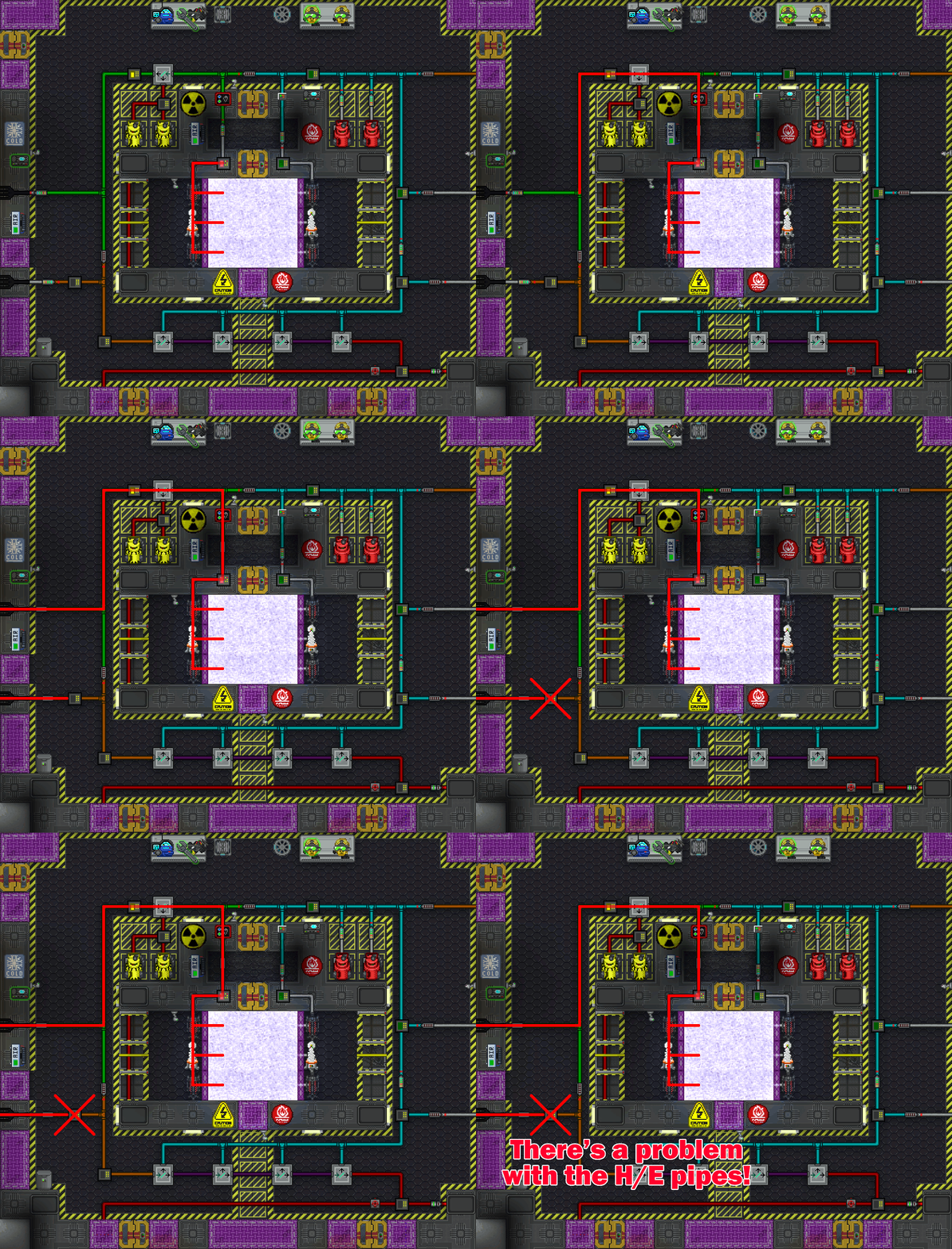
Beyond these few tips, you will have to begin actually looking for the fault in the engine. The Supermatter is on fire for a reason, you need to find it or the fire will just start again!
Inspect the gas loop to confirm it is intact and operational.
Check the  meters to quickly ascertain where a problem may lie.
If any of the meters report an unusually high or low amount of gas, then you're close to finding the issue!
Common gas loop failures include:
- Gas pumps are OFF or left on the wrong pressure (Crank them up to 4500kpa!).
- Gas filters are OFF or set to the wrong gas. Remember! Filters do not allow ANY gas to pass through if they're turned off! If you don't wish to filter anything, leave them online but set to filter nothing.
- Part of the coolant loop has been broken or unwrenched. You must don a space-worthy suit and go fix it! This may mean wrenching it back or recreating it with your RPD .
- Supermatter chamber air alarm has the vents improperly configured. Turn turn off both internal and external regulators, make sure ON is toggled.
- Supermatter chamber scrubbers not siphoning or turned off. Set to siphoning, expanded range, and ON.
- One of the pipes has been broken or unwrenched. You can easily put it back in place with a wrench or recreate it with your RPD .
- Too much gas for standard setup! Remember that gas pumps are the lowest tier for circulation. If a section has too high of a pressure, the pumps cannot push anything more into it!
- Too little gas! The more (cold) gas there is, the faster the gas will be able to siphon heat away from the crystal. A Supermatter crystal in near-vacuum is just looking for an excuse to overheat.
- Did you set the filters to allow Pluoxium
 or Water Vapor
 ? These often form during delaminations and may help you keep the crystal cool!
Sabotaging the Supermatter
Want to sabotage the crystal but can't figure out how to pull it off? Here are some pointers and hints:
General Hints
- You can break the APC of the room to stop all pipes and scrubbers from working.
- Cut cameras near the engine.
- Straight piping the Supermatter coolant loop greatly increases the rate of delamination. It can also be saved easier, so ensure it is not corrected fast. A non-robust engineering department is doomed.
- Instead of turning off pumps and filters, you can just set them to extremely low values instead. They'll still appear to be working while actively slowing the cooling to a halt!
- Taking out all the engineers before attempting a delamination helps a lot.
- Opening a canister of plasma in engineering and igniting it will make it a lot harder for people to fix your sabotage. Even more effective if the radiation levels are high.
- Keep a flash or EMP on hand. The AI and its borgs are pretty much guaranteed to try and intervene to prevent harm.
- Stay around and pretend to be helping so you can undo all the repair attempts by other people.
- With a little bit of tinkering, you can sabotage the station's distribution loop with any of the multitude of harmful waste gases produced.
Regular Delamination
These are the easiest to pull off and require no special conditions. You can cause a normal delamination by:
- Turning down or turning off gas pumps
- Turning off or changing the gas on a gas filter
- Unwrenching any pipe. Note: This will release all gases stored in said pipe (bad if plasma or superheated gas).
- Shooting guns at the crystal is extremely effective, but it's likely that you'll end up in the blast.
- Disabling the scrubbers or vents in the air alarm.
- Adding a very harmful gas like plasma, but make sure you have the gas filters set to allow it in circulation first.
- If you plan to delaminate the supermatter, consider cutting telecommunications or edit it so it filters Engineering out. They wont hear the warnings until it is too late...
- Stealth sabotage: Unwrench a portion of the space loop. Generally, no one looks in space to correct this, and it is not obvious a piece is not connected.
Overcharged Delamination
This kind of delamination requires careful gas management but is faster, far more destructive and there's a good chance it will irradiate, burn and shock the engineers who are trying to fix it.
- Wear as much radiation protection as you can. Hide or destroy the rest.
- Wear insulated gloves so you are not shocked by arcs. Destroy any other gloves remaining.
- Shut off all cameras.
- Keep the emitters online and firing. Add extra emitters if possible. You can swipe an ID to lock them (which even the AI is unable to bypass), but the wires can still be cut.
- Break into atmos and configure pure CO2 to be sent to the engine coolant loop. A better way of doing this removing the pipe into atmos from space and rerouting it that so it cannot be turned off.
- (Optional) Deal with tcomms through destruction, depowering, or filtering out the Engineering Radio Channel.
- Now to start the delamination. Set all air filters to CO2.
- If needed, enable the pipe of CO2 from atmos you configured earlier.
- Access the air alarm and turn off scrubbers. Pump as much CO2 into the chamber as possible.
- Sabotage entry to the room, and/or release plasma in the room around the SM chamber.
- The anomalies, gravity pulses and lightning arcs will quickly turn the engine room into a deathtrap. Make sure you have everything set up correctly before this starts happening.
- The engine will start broadcasting obvious and dire messages that something is very wrong over common radio frequencies. If comms are down, this is not a problem. Note: People carrying laptops, PDAs, or tablets can still see the engine status.
- Stick around only long enough to ensure that it is not stopped.
- Embrace the energetic god.
Critical Mass Delamination
A critical mass delam is one of the more difficult methods. It takes longer and there is a chance it reverts to an overcharged delamination. It follows the steps of the previous delamination, but instead we will be pumping plasma from atmospherics. The goal is to have as much gases selected at the filters.
- Get the gear.
- Straight pipe the system.
- Cut the cameras.
- Select four different harmful gases - Oxygen, Plasma, Tritium, CO2. Alternatively if you immediately start pumping N2 from atmospherics to the SM at the start of the round it will delaminate in about 12 minutes.
- Disable the scrubbers from the air alarm OR unwrench part of the pipe leading out.
- Sabotage the room.
- Stay close until it's too late to save.
- Run like hell.
- The Lord arrives.
Cold gas, a glowy crystal, some lasers, and you: A deeper dive into the Supermatter Engine
This is very rambly, but useful information will be given throughout. It's recommended to read it all, as it covers critical aspects of atmospherics functionality and, thus, the Supermatter. But if you just want the conclusion on a whole lot of theory, skim read the bulk of it but pay attention at the end.
The basics of gas. Rule 0 of atmospherics and the Supermatter
First things first, and extremely importantly: gas does not work like you think it does.
A common, and reasonable, misconception is that gas flows. In atmospherics, gas does not move from one pipe to another. Instead, gas “Exists omnipresently within a pipenetwork”. What this means is that gas within a pipenetwork (commonly referred to as just a pipenet) exists in perfect equilibrium of both gas and temperature. If you have a pipenetwork from one end of the universe to the other, and added let’s say 1 mole of oxygen, then there would immediately be gas at the other end of the universe. Every single pipe would have the exact same gas, at the exact same pressure, at the exact same temperature. Say we then add some N2O, then the exact same thing would happen. The gas, mixed perfectly with the oxygen, across every single pipe.
tldr; gas behaves more like electricity moving across wires(I.E. instantly) than IRL gases
Now it’s important to clarify what exactly a pipenetwork is. A pipenetwork is any connection of pipes wherein a pipe can be traced to another pipe via at least 1 pipe. So it doesn’t matter how many pumps you have between your pipes if even 1 length of pipes can be traced around those pumps. At which point, it’s part of the same pipenetwork, and the pump is irrelevant.
This might sound a little weird. To clarify, don’t think of pipes like a method of transport. Nothing travels through pipes. Think of pipes like a container for gas.
For this, I like to use the basin analogy. Imagine you have 3 things: A basin or bucket or something similar, a cup, and some liquid. The pipes are the basin, the cups are the pumps, and the liquid is the gas. If you add something into the basin, it doesn’t travel in a direction towards the next area, it simply enters equilibrium with the rest of the contents (please ignore brownian motion for this analogy. If you don’t know what this is, good, it’s not helpful here). If you want to move something from one basin to another, you dip a cup in and pour it into the next basin. That’s how pumps work. They, like the cup, move the contents from one container to another in bulk loads.
Call back to what I said about pipenetworks and pumps a moment ago. Having a pump inside of a pipenetwork is like using your cup to take out of the basin and pour back into it. It accomplishes nothing, because the contents aren’t changing.
So with this in mind, how does clogging occur?
A horror story of pumps and hot gas
Pipes do not clog, period. Filters clog, pumps clog, scrubbers clog, vents can clog (depending on settings). But pipes, however, do not. There is no upper limit on the pressure of pipes. A pipe, in theory, can store infinite pressure and, thus, infinite gas.
However, there is an upper limit on what pressure pumps, filters, and scrubbers can get into pipes. This may sound similar, but it has large consequences.
For example, a pressure pump has a maximum pressure of 4500 kPa. That means that every time it pumps gas, it can move up to but no more than 4500 kPa of that gas. It also means that if the pressure of the pipenetwork it’s pumping into is equal to or greater than that value, it will be unable to move the gas. This is referred to as a pump becoming backed up or clogged.

To the right you'll find an image used earlier in this guide, but it is updated to show the separate pipenetworks the roundstart Supermatter has on Box station. Each of these pipenetworks is separate, but are in perfect equilibrium within themselves. So if you checked the gas in the green pipenetwork, it doesn’t matter where you checked, it would display the same. Likewise, the blue pipenet may be different than the green pipenet. But everywhere in the blue pipenetwork you check would, again, be identical to anywhere else in the blue pipenetwork.
But dear Mr. Guide Writer, why does this matter, at all? Why show me just how many pipenetworks exist in the round start setup, what does it matter? Two reasons.
- Pumps, filters, and mixers do not efficiently pump connected pipenetworks at all.
- Gas. as mentioned earlier, is always evenly spread through a pipenetwork and without direction to it. (“Gas exists omnipresently within a pipenetwork”)
Let's start with the first thing, pumps. All types of pumps (not filters and mixers and the like) have 200L volume in the small bit of pipe before them, and 200L in the small bit of pipe after them. As such, a volume pump pumps all the gas that is in that node to the other side of the pump, per second (the maximum pump rate for volume pumps is 200L/s). As such, if a pipe network has 2000L of volume, connected to a volume pump that is pumping at its max rate, it will pump 1/10th of all gas in the network, per second. However, you also have to take into account that it's always 1/10th of the gas that is in the pipes, as such, pumps will pump less moles of gas per second as there is less and less gas in the network before the pump.
Put simply, pumps exist to restrict and direct gas by their very nature. If you need to move gas from one place to another quickly, adding a pump will only slow it down. Starting to see where this is going? Well, there’s another reason pumps are bad, and it ties back in to the previous section.
Pumps have an upper-pressure limit, same for filters and mixers. For the gas pump, and the others, the pressure limit is plain to see, 4500 kPa. However, the volume pump also has a pressure limit, rated at 9000 kPa. Scrubbers in fact also have a pressure limit, sitting around 5200 kPa.
Gas pumps and mixers are especially poor, as their pumping slows down the closer they get to their pressure limit.
What does this mean for the Supermatter, especially in case of delamination? Well, the room is probably on fire, so the gas has expanded, which in turn makes it far more pressurized. The knock-on effect? Follow along with the image to the right. We’re starting at the left side of the central Supermatter chamber. The yellow pipenet before the red.
- Yellow: First, the scrubbers work their butt off to get to their pressure limit. The gas is hot, so that doesn't take very much.
- Red: While this happens, a gas pump takes the tiny amount of moles in the pipenetwork the scrubbers are connected to and shoves a small amount of it into the pipenetwork beyond it. Slowing down even further, as the gas is so hot it easily reaches the pressure limit.
- Blue: This then reaches the filter, which again tries to pump the small amount of moles beyond it, with another case of pressure limit slowness and the fact, not all gas is available for pumping at any moment.
Repeat the above for all the following pumps. Add to this the fact that the Supermatter produces plasma and oxygen, which are reacting with each other and burning in the pipes, likely pushing the pressure above the limits of what the pumps can handle and... well you got the point right? That’s what happening to your pumps every single time the Supermatter ignites.
Well, that all sounded horrid, how can we prevent this?
How removing pumps made me a billionaire
The title gives it away, really. You want to replace most pumps you can find with either straight pipes, or with valves to allow for easier modification and changing where the gas goes on the fly. ESPECIALLY THE FILTERS NEED TO EITHER BE REMOVED OR UTILISED PROPERLY IN THE CASE OF A DELAMINATION OR WHEN OPTIMISING.
Now, to explain why this is the proper option in most cases. As mentioned continuously, gas in a network is always evenly spread through all connected pipe. it's always the same ratio of gasses, it's always the same temperature. It’s always in perfect equilibrium in every sense of the word.
If you’ve been following along, then you likely know what this means. By replacing all the pumps up to the space loop with pipes, clogging is no longer an issue. The gas will leave the supermatter and immediately be cooled by space. No delay, no travelling, because the pipe connected to the scrubber holds the exact same amount, temperature, etc as any of the pipes in the space loop (marked as Green)
But, why stop there? You already know that gas doesn’t travel inside of pipenetworks, so these other two pumps (Blue to Red | Green to Red) aren’t actually assisting in cooling after all* (There will be a small note at the end of this section) so why not simply replace them with pipes? Well, that has an added bonus. In a standard setup, or any setup which stops gas flowing from Blue to Red, the only connection between the gas return filters (Green circled filters at the bottom) is the heat exchange pipes in the space loop. If somewhere were to cut one, then the gas could no longer reach the return filters. Eventually the supermatter would run out of coolant, and a delam would begin.
But, say those pumps were both turned into pipes. Well, then cutting a single pipe in the space loop would do next to nothing. We’d lose the gas from that one cut pipe, but the rest of the piping is still connected, and the engine continues safely. You won’t even notice the change.
“Wait!” you may be thinking, “the pipes will leak!”
Thankfully, that makes far too much sense for atmospherics. Pipes don’t leak. At all. Now, the gas that was within that specific pipe will be expelled into the air, yes. But the gas from other pipes can and will not exit out of the newly made ‘opening’, if you can call it that.
So that’s two very nice bonuses. Gas is immediately cooled, and the supermatter is harder to tamper with. It’d would be fine if that was all these changes gave us. There’s one more nice bonus, though.
The volume of the pipenetwork is increased massively. Pumps, as we’ve discussed, have a pressure limit. The greater the number of pipes in front of a pump, the greater the volume that the pump perceives, and the more gas it can put in. Put simply, if you have a single pipe of 4500 kPa, a pressure pump cannot continue pumping. Add another pipe, and suddenly it’s 2250 kPa each, and the pressure pump will continue until both pipes are 4500 kPa. Every time a pipe is added, the ‘capacity’ increases. By replacing all these pumps with pipes you have changed a number of pipenetworks of only 10-20 each to a full pipenetwork of 50+. Suddenly the scrubbers don’t have to worry about pressure as much, especially on top of the instant cooling.
Lastly, though only vaguely related, keep your vents on internal 0, not on external 5000. Vents do not actually have a pressure limit at all. They can continue to add pressure constantly, however, they do work faster if the chamber they are connected to is lower pressure, and the gas they're pumping is cold, but this is always true. Essentially, vents pump a static amount of pressure when they're at maximum speed. If nothing very, very strange is happening, the gas that the vents are attempting to pump in is colder than what is in the chamber, as it already went through the cooling part of the pipes. As such, having the vents on internal 0, and with it, always pumping the hardest they can, they are adding gas that is colder than what is currently in the chamber itself. This contributes to the cooling down of the chamber, and is often enough to prevent a heat delamination by itself.
External 5000 suffers from the same issues as a pump does, vents will completely stop pumping in gas when the room it is trying to pump into is 5000 kPa or above, which happens fairly quickly in a small room that is white hot. So remember, internal 0, unless there is too much gas in the room (see singularity delamination).
* The small note at the end of the section: You can consider placing restrictive pumps in certain areas so hot gas can't travel through quickly and give it more time to cool, though there are often better ways to do this that are less dangerous. Still, the option is there.
Breaking the laws of thermodynamics and a final word
EDIT: Space is now 2.7K making it the best cooling solution at round start and equal to t4 freezers.
Freezers. That is all. Freezers are magical machines that break the laws of thermodynamics by even existing and work to extremely quickly heat or cool gas to the temperature they are set at. They are much, much quicker than space could ever hope to be when upgraded, and even colder. Space, at its coldest, is about 26K. Freezers can go as low as 2.7K when fully upgraded, and are much quicker at cooling. A word of warning, however. Freezers will attempt to change the temperature of the gas that is in them to the temperature it is set at, this seems obvious, but that also means it can heat gas. As space is around 26K, and unupgraded freezers only go to 73.15K. As the gas is returning from space, this will often serve the heat the gas. However, as 73.15K is still far cooler than any worrisome temperature for the Supermatter, it’s worth considering leaving them on depending on your setup. As during a delam, gas can return from the space loop still warmer than you’d like it, and it adds a second layer of security just in case. Especially if something… Unfortunate happens to the piping out there.
If you somehow read through all that, I very strongly applaud you, and I applaud you on likely becoming an engineer that is a few times less clueless. Despite all the things you now may know, there is a lot to experiment with, and lots of ways left to mess up in spectacular ways. Try to keep learning more and more as you go, and good luck in your attempts to not blow up the station.
How to cool your Supermatter to where it may become a problem
Your Tablet
Normally, most people just throw this away at the start of the shift but your tablet has a program to monitor the SM. Its good practice to take out your tablet to immediately download the Supermatter Monitoring app at roundstart. Simply keep your tablet on this and in your pocket and you will be able to constantly see the monitor for the entire round, instead of having to go to a static computer every time you want to look at its status.
Pressure vs. Volume
Normally, your Supermatter is equipped with pressure pumps which max out at 4500 kPa, the problem is that they aren't that fast. In theory Volume pumps are just as fast, but they can pump until 9000 kPa. This means that in case of a heat delamination they can continue pumping even when normal gas pumps would already have given up. By replacing everything that uses pressure pumps to volume pumps you can make the cooling of your SM a lot faster.
Pump Cleanup
The even faster way to cool your SM is to remove all of your pumps except for the ones infront of the canisters and the atmos to loop pump and then replace all of your pumps with pipes after. Pipes have no upper pressure limit, so they will never get clogged. Another benefit of straight-piping is that gas is omnipresent within a pipenet, meaning that if you have no pumps between your scrubbers and the space loop your gas is going to get cooled immediately!
The other layers
A huge part of the SM is the speed you can get gasses from the scubbers to the vents, the first and third layer helps a ton with this. By setting all your things with layer adaptors behind them and a device for every layer you can make everything a lot faster.

Filtering with the other layers
Normally you get 4 filters all on the second layer, but these are useless and just slow down the unfiltered gasses. Instead of having one filter you're gonna need 3 filters with layer adaptors before them.
Each filter normally filters at 200 L/s but with the layer adapators you're gonna get to 600 L/s, making your gas a lot faster since all filters can move the gas at the same time (Since gas is omnipresent within a pipenet) instead of moving it from one filter to the next.
You are also gonna need two of these for the next cooling strategy, one for going into the cooling loop and one for going into the SM.
Plasma Cooling
Plasma may be seen as a gas that can heat up quickly and makes fires, but it can be used to cool down your SM way more. The reason for that is that Plasma has a very high heat capacity (200) compared to other gases (for example, Nitrogen has a heat capacity of 20). The higher the heat capacity, the more energy it takes to raise the temperature of the gas. So you could disconnect the space loop from the rest of the cooling loop, fill it with plasma and connect both loops with heat exchangers so the cold plasma cools down the gas inside the normal cooling loop.
Plasma can keep a very cold temperature for a long time and if you filter it out of the SM into the cold loop and use it for further cooling you can keep your SM very cold.
Space cooling with the other layers
Just what it sounds like, add 2 more layers to your space cooling and it provides a great boost to how cold your SM is.
Your Freezers
The freezers you are given can be your savior but also your demise. The problem is unless you have upgraded their parts to T4 parts (the bluespace ones) it will actually heat up your gas instead of cooling it down. If you ever turn these on it will provide a great cooling boost but is not recommended below T4 parts or in an emergency.
The useless Additions
The pump infront of the SM, the bypass pump. I don't even know why it exsists but you should always remove this and change the pipes from manifolds to normal pipes. Edit: I was told this was used so rather then pumping gas into the SM you could put it into the cold loop to keep gas colder, but I've never used this myself.
The Filter to canister in the upper left corner of the cooling loop can be useful if you want to farm gases like Pluoxium with a CO2 SM, but in most cases you should remove this and replace it with a normal pipe so your coolant isn't getting slowed down on the way to the space loop.
However, you can also place a layer adaptor in front and after the filter and connect it with a straight pipe on another layer. Through that, the gas will not be slowed down because it can travel through the normal pipes, but you can also farm gases because the filter is still functional, meaning this setup has no real downsides.
Passive venting
Normally a SM has unary vents which if you set your air alarm up correctly will try to deplete its pipes to 0 kPa. Passive vents however link the atmosphere to the pipes, so the scrubbers will be scrubbing directly from the pipes and it will make gases going into the SM a lot faster. Be very careful when putting these into the SM room, one touch of the SM and you are dead. It is also recommended to put a holofan infront of the SM so gas isn't leaked. Also, this will cause your SM to lose gas because the gas goes into the pipes so make sure everything else is ready before putting these in.
Scrubbing and cooling under the SM

Putting things under the SM is dangerous, but if you want to cool it more this is the next step and recommended for setups that involve dangerous gases. By alt-clicking the SM you can view the floor under it and put pipes and devices under the SM. You're gonna need heat transfer pipes and scrubbers.
The Scrubbers
The scrubbers should not be scrubbing all the air but instead should be scrubbing all the O2 so a fire doesn't start and heat up the SM a ton.
The Heat Transfer Pipes
By adding heat transfer pipes with plasma and freezers hooked up to them you can greatly cool the SM. But if you change these to heaters you can also greatly heat the SM, resulting in a delamination. The freezers have to be equipped with Tier 4 parts or they will be less efficient than space.
The Anomalies
Once reaching 5k MeV (More at 7k MeV, however 5k is the safe upper limit), 7000 Kelvin or enough pressure, anomalies will start appearing outside the SM. This is a big problem because of their affects:
The easiest way to prevent anomalies from causing harm in engineering is completely removing all floor tiles leaving the cold space surrounding the SM, wrenching or remove anything that can move and welding the regular vents and scrubbers around the engine. Make sure you have a spacesuit or hardsuit of course.
Don't forget that these anomalies can yield anomaly cores which science loves.
The Pyroclastic Anomaly
The Pyroclastic Anomaly will spew out burning plasma and slimes which can make it very hard to contain the SM because everyone without sufficent heat protection will burn to death, or if you somehow survive the fire you will be greeted by very angry slimes. The best way to reduce the affect of this anomaly will be spacing the area around the SM so all the plasma from the anomaly will go into space and no fire will start. The slimes will also die from space if you do this because slimes do not like cold things. However, make sure to avoid the slimes because they do cellular damage which is very hard to heal.
The Gravitational Anomaly
The Gravitational Anomaly will pull anything unwreched and unanchored in its surrounding to itself. While not directly harmful, it can be quite annoying because it can throw you around aswell (This can be stopped by wearing magboots). It can also cause all the slimes from the pyroclastic anomalies to get sucked into the SM and slam them into it, causing a boost in MeV. This may be funny when it first happens, however the resulting power boost can result in even more anomalies or speed the delamination up.
The Shock (Flux) Anomaly
The Flux Anomaly is probably the most dangerous anomaly, as it can easily just shock you in a corner and kill you. Not even wearing a hardsuit and insulated gloves will protect you, so avoid these at all costs or you may die easily.
If you have done all of this you should be ready for a SM of pure CO2 or a little bit of tritium or something.
AN IDIOT'S TL;DR
Welcome to bottom of the page, friend.
Did that seem like a lot of information? It sure feels like it.
Hell, maybe you didn't even read it!
FINE!
Here a few pointers. Just for you, buddy.
- Heat bad
- Pressure bad
- High N2 good
- low O2 good
- low plasma good
- Pumps bad
- straightpipes good
- Mess with the SM air alarm scrubbers and vents LAST
Hope that helps, pal.